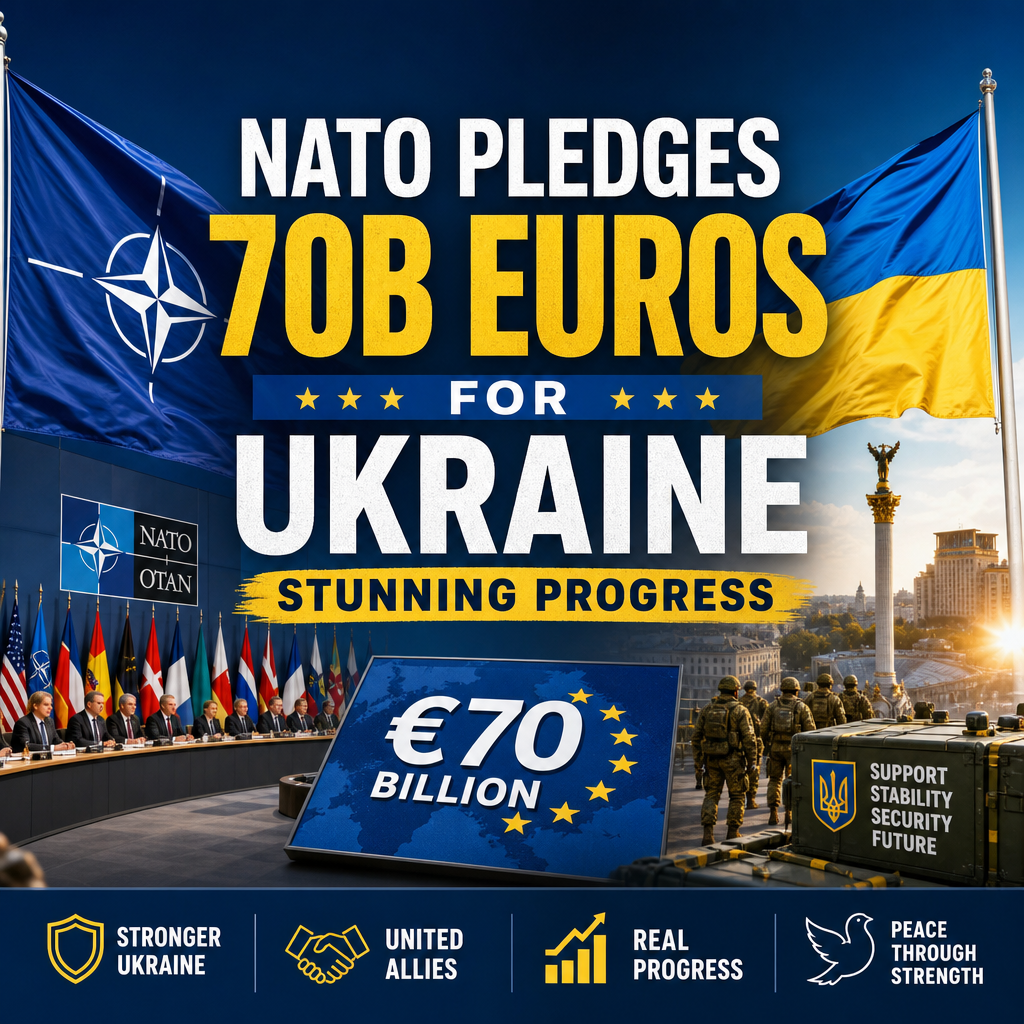
NATO Pledges 70B Euros for Ukraine: Stunning Progress


NATO Pledges 70B Euros for Ukraine, and the scale of the commitment signals that allies are still trying to match battlefield urgency with long-term political staying power.
The headline figure matters not just because it is large, but because it arrives at a moment when the war is being interpreted in very different ways by different capitals and media outlets. For supporters of Ukraine, the pledge suggests that Western backing has not weakened despite the war’s length, the cost to taxpayers, and repeated questions about ammunition stocks and industrial capacity. For skeptics, including outlets that tend to emphasize the burden on Europe and the risk of escalation, the announcement can look like another expensive promise in a conflict with no easy military endgame.



What is clear is that the package is intended to keep Ukraine supplied and resilient. What is less clear is whether the money alone will shift the strategic balance.
What the 70B euro pledge actually signals
The reported 70 billion euro commitment should be read as both a practical and political message. Practically, it reflects an effort to sustain weapons deliveries, training, logistics, and support systems that Ukraine has relied on throughout the war. Politically, it tells Moscow that NATO members are still prepared to absorb costs rather than allow fatigue to define the outcome.




That said, the timing also suggests a familiar dilemma. Western governments often announce large support packages with strong language, but the real question is how quickly those commitments turn into usable equipment, shells, air defense systems, and financing on the ground. Aid delays have repeatedly mattered in the war, and any new pledge will be judged less by the size of the number than by delivery speed.
There is also a diplomatic layer. Ukraine’s allies want to show that support remains coordinated, especially after years in which individual members have differed on how far to go, how much to spend, and what kind of victory is realistic. Some capitals favor long-term military assistance; others are more cautious, wary of stretching their own budgets or deepening confrontation with Russia.
A message to Kyiv, Moscow, and Washington
The pledge appears aimed at three audiences at once:
– Kyiv, to reassure Ukraine that support is not fading
– Moscow, to signal that pressure on Russia will continue
– Washington and other allies, to demonstrate that burden-sharing is still alive
That third point matters more than it may seem. NATO unity has often been tested not by dramatic disagreements, but by practical ones: who pays, who delivers, and who takes the political risk at home. A major collective pledge can paper over those tensions for a while, but it does not remove them.
Reading the reactions: support, caution, and skepticism
Coverage across international outlets reflects three broad viewpoints.
One camp sees the announcement as evidence of progress. From this perspective, the alliance is doing what it has promised to do since the full-scale invasion: adapt, scale up, and prevent Ukraine from being outmatched by Russian firepower. The argument here is straightforward: if Ukraine is to negotiate from strength, it needs sustained Western backing, not occasional bursts of attention.
A second camp is more cautious but not opposed. These voices tend to acknowledge the necessity of support while warning that funding commitments do not automatically solve battlefield problems. They ask whether Europe’s defense industry can actually produce at the required pace, whether stockpiles are adequate, and whether the political will will last if the war drags on into another year.
A third camp, more critical of NATO policy, focuses on the cost and the risk. RT-style framing, for example, typically emphasizes the danger of escalation, the drain on Western resources, and the idea that military aid prolongs conflict rather than resolves it. Even when one disagrees with that conclusion, the critique does raise a legitimate question: what is the end state? A war can be sustained for a long time without becoming any closer to settlement.
That uncertainty is the central contradiction in the current moment. More money can strengthen Ukraine’s position, but it cannot by itself create a peace process. And peace, if it comes, will almost certainly require some combination of military deterrence, diplomacy, and political compromise that no single pledge can deliver.
Trump’s praise for “peace progress” adds a political twist
The reporting also notes praise from Donald Trump for what he described as peace progress. That matters because it introduces a different political logic into the story. Trump has often framed the war less as a long-term security struggle and more as a problem to be managed through deal-making and pressure for negotiations.
That outlook could align with some public fatigue in the West, especially among voters who want an end to the war even if the terms are messy. But it also creates a tension with NATO’s more traditional message: that support for Ukraine must continue until a durable and credible peace is possible.
The gap between those positions is important. “Peace progress” can mean almost anything, from indirect talks to rhetorical softening. Without clearer details, it is hard to know whether Trump’s remarks reflect a real diplomatic opening or simply a political attempt to sound constructive while the war remains unresolved.
The bigger picture: progress, but not closure
The most honest reading of the NATO pledge is that it represents real progress, but only in a narrow sense. It shows that allies are still willing to commit substantial resources, and that Ukraine remains central to European security calculations. It also shows that the war has moved beyond a short-term emergency and into a prolonged contest of endurance.
But this is not a tidy success story. The conflict remains violent, costly, and unpredictable. A 70 billion euro pledge can help Ukraine hold the line, strengthen its negotiating position, and reassure its supporters. It cannot, however, guarantee battlefield advantage or a lasting settlement.
So the right conclusion is cautious. The pledge is significant, and likely necessary. It is also a reminder that the West is still buying time in a war where time itself has become one of the main weapons.